
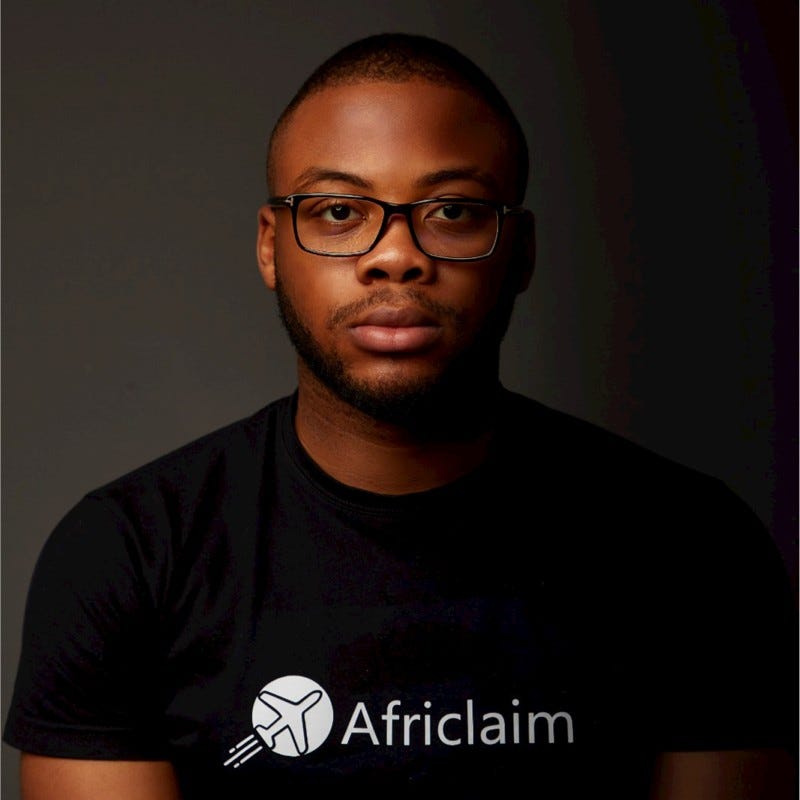
"Knowing when to stop talking is important!" ... CEO of Africlaim, Chibuzo Ofulue
"It takes a lot of confidence to approach a stranger and tell them about your business and what you do; knowing the right things to say and knowing when to stop talking is important!"
Akachi’s Leadership Yard is an email newsletter bringing you exclusive leadership tips, advice, and lessons, from business CEOs, founders, and creators all around the world. Delivered straight to your inbox; no hassle.
I spoke to Chibuzo Ofulue recently, the 23-year old co-founder and CEO of Africlaim, one of sub-Saharan Africa’s fastest-growing air passenger experience startups. He is also a fellow Loughborough University alum!
Our discussion covered various areas, from why he and his high-school friend, Ifeanyi, decided to start Africlaim, and their toughest business moments, to how he unwinds after a long day, and what skills he has developed in his entrepreneurship journey.
Africlaim helps passengers turn their delayed, canceled or overbooked flight into compensation up to 600 euros. In practice, it takes less than 5 minutes to file a claim with the service and less than 3 weeks on average to receive your compensation. Your claim is them assessed and submitted to the airline for free. Africlaim only gets paid if you get paid. Even better news? Depending on the relevant regulation, you can claim as far back as six years.
Quick Facts
Name: Chibuzo Ofulue
Age: 23
Country: Nigeria
Best Known for: CEO and Co-founder of Africlaim
Industry: Passenger Experience (Aviation)
Education: International Business (BSc) Air Transport Management (MSc) from Loughborough University
Akachi: So, how’s business Chibuzo?
Chibuzo: Good... Good... Good... Everything is good. Moving forward.
I’ve just come back from a trip to Nigeria. We were there pitching for the final stage of grant competition hosted by a Dutch company. We came in second place and received a prize money was 20,000 Euros, as well as an invitation to join an entrepreneurship school in the Hague very soon.
We had a very strong case and it was such a good experience. We were aptly recognized for our great delivery, and I feel that the experience has opened doors for bigger opportunities going forward.
I’m particularly excited about going to the Hague! It’ll offer amazing networking opportunities with founders and creators from other countries such a Ukraine, Uganda, India, South Africa, and others.
Akachi: So, the trifecta - when did you start Africlaim, how many of you did so, and where?
Chibuzo: Basically, my best friend and I founded Africlaim in 2017, so just over 2 years. However, we officially incorporated the business in 2018. I’ll tell you the story.
My best friend, Ifeanyi, was on a delayed flight a few years ago. It was a major holiday, either Easter 2017 or Christmas 2016, and he was coming back for a break. During the reached out to me when he was at the airport, just to update me on the current state of things – as friends do. A few weeks later though he mentioned the experience on his Twitter account and he started to notice bot-like accounts reaching out to him and telling him he was entitled to get some money back.
The accounts seemed like fake accounts, but we decided to investigate their claims regardless, and then we discovered that there was an actual federal regulation that held airlines accountable for flight delays, cancellations and over-booking. The regulated stipulated that they were liable for compensating apt parties for up to six hundred euros, if they delayed a flight for up to three hours, cancelled it, or other criteria.
Intrigued, we conducted some more investigation and discovered that some people had, in deed, gotten compensation through third parties. To cut a long story short, we consulted with a friend who worked in the legal field, and after a month of being in the process, my friend Ifeanyi received his compensation. In cash. We were amazed.
It was like a ‘wow’ experience, as you’d not expect such legal compliance or compensation somewhere like Nigeria where the law is easily skirted around, and cases can take ages before receiving any attention. We’re in 2020 now as well, so this might not seem like a big deal, but just three years ago it was!
In Nigeria, the statistics on flight compensation are shocking, especially with regards to awareness around it. For example, last year, we went into Saka Tinubu, a major business district in Lagos to survey people’s knowledge on claiming compensation for delayed, cancelled, and over-booked flights. None of the participants knew that that was even a thing.
A lot of Nigerians will complain about a delayed flight, but many aren’t aware that they can get some cash back for it. This has to do with the rule of law there; it is not often upheld, and people do not believe they will be compensated by these airlines because legal injustice is rife.
The survey cut across income class as well.
Akachi: Give me more of Africlaim’s story; how did you begin the enterprise?
Chibuzo: So, back in 2017, when getting paid for a flight delay was still quite unheard of in a place like Nigeria, we opened a Twitter account. It was called Claim Agents or something along that line, and we used a free logo created online. We started to tweet at random Nigerian people who had tweeted about flight delays in the country; we would send them information about their eligibility to get some of their money back, and – you guessed it – a few people replied asking us to help them out. In such cases, we gathered information from them and carried out the whole claim process on their behalf.
Frankly, it wasn’t easy. As you can imagine, people were skeptical. A Nigerian, asking you for passport details, flight details, account details etc. on the internet. Even I wouldn’t give a random person on Twitter my details. But some people took that leap of faith and, with our guidance, they received compensation for the inconvenience caused by the airlines.
After a few early successes, we decided to make the information sharing process more sustainable by creating a simple webpage where we put the bulk of useful information. So, if we got new enquiries we could just direct them there instead of typing out everything again to every individual. Soon enough, we introduced a functionality that allowed people to submit their details online. We had gradual improvements like that, and still do.
It has been very exciting, ever since our first experience of the compensation working for us. It’s like when you watch an amazing show, and you just want to tell everyone about how great it is and why they should watch it too … yes, that feeling.
It was really fast-paced and, toward the end of 2017, someone reached out to us from a newspaper, wanting to interview us. That was when we decided to make the business more legit. We decided to turn it from a casual business venture into an actual corporation and get more people onboard. We completed the process in 2018.
Akachi: It’s a very interesting story! Seems you didn’t just sit down in your apartment one day and think “Why don’t we start an airline compensation business?”. You tested the idea in the market, and saw that it worked, before turning it into a company.
If you were to describe Africlaim in just one sentence, what would you say?
Chibuzo: Get paid when your flight gets delayed.
Akachi: Oh that's good. It even rhymes. And do you focus just on Nigeria?
Chibuzo: Yes, the focus is on Nigeria right now. Long term we’d like to expand to other countries in Africa. We get many questions from potential investors regarding why we are not expanding into Europe. The reason is because our core mission is to raise awareness in Africa regarding this flight compensation issue. People in Europe are more knowledgeable on the process as people claim compensation for flight delays and cancellations all the time. But it’s not the same the same here. Here, no one knows, and no one cares. There isn’t even enough research directed at this area, so there’s a huge opportunity to make an impact.
Akachi: I see things from your point of view! I don’t remember the last time someone I know back in Nigeria got their money back … or even cared enough to try. This especially applies to the older generations who are less tech savvy and book flights through travel agents who never mention compensation anyways. In fact, I won’t be surprised to find out that travel agents claim back money when apt but don’t pass it on to the original travelers.
Chibuzo: Yes. Trust me. I can’t go into more details because of like privacy policies etc., but some things you’ve just said are not far from the truth at all. Trust me.
That’s the sort of thing that I want people to know about – because if you don’t know, you can’t act. I’m very passionate about spreading this like a gospel in Africa. We’re starting with Nigeria, but want to gradually branch out to other parts of West Africa etc.
Nigeria has the largest population in Africa, with a massive international airport servicing numerous flights every hour. It’s weird how there’s not a lot of transparency with regards to passenger experience and your entitlements as a flyer.
Akachi: How many people are in your team at Africlaim?
Chibuzo: At Africlaim, we have five core team members (two co-founders, a COO, a Head of Marketing, and a Head of Legal). When we started, we used to outsource most of the legal activities to a third-party law firm but then we decided to get our own in-house person, as it can be tricky dealing with customer data and we want to be on the safe side.
One interesting development – we haven’t shared this anywhere else yet – is that we will now have a physical stall at the Murtala Mohammed International Airport. This is very exciting.
You might not have airline compensation on your mind normally, but seeing a physical presence dedicated to it at the airport at least makes you more aware of the possibilities. We will be in the check-in hall.
Akachi: How did you get that sorted?
Chibuzo: That’s a long story; it could take up a whole separate interview. You know the things work in Nigeria. It is a very very long story.
It wasn’t straightforward. We have been working towards this for over a year now, and we just started making like significant headway in December. Getting things done in Nigeria never works in a straight line.
Once we do setup in the airport though, our numbers are going to increase in terms of people we onboard and we would be able to reach out to more people.
What I’ve realized is that people in this part of the world (Nigeria) respond better to body language than verbal or written language. They read less but interact more in person. So, if you can’t branch out further than your websites, online platforms, and content, you’d be limiting how effectively you spread your message.
Culture has a huge impact on everything. People respond very differently based on the environment and I personally believe Nigeria isn't really at the digital age a lot of people outside the country tend to want to believe.
There are a lot of business models these days (especially exhibited by the likes of FinTech and mobility startups) that can’t fit with the current market environment in Nigeria. Forcing it to work is sad to see; it’s a flawed copy and paste syndrome.
Akachi: What has been your scariest business moment within the last 12 months?
Chibuzo: Very good question. I mean, it’s relative, really. Every new week comes with its own challenge and it depends on like what is going. Let me think [long pause]; maybe it's just the way I look at things, but I really haven't had one. I tend to see things in a binary manner. It's either you succeed at getting your desired target or you succeed at learning from that target albeit it was missed. So, nothing has been super scary to me.
Notably, the process for obtaining the 20,000 euros grant made me quite anxious. Even though it’s in hindsight now, I still can’t decide if what we did was a mistake or not. Basically, even though we hadn’t won the grant, we made a lot of budgets and forecasts based on the anticipated funding. We were quite arrogant. As the time for the competition drew nearer, so did the pressure of having to think of what would happen if we didn’t end up with the money in our account. We felt we had two options: to win or to win. Our minds started playing tricks on us: What if this we don’t win this?
Akachi: Do you think the pressure pushed you forward though?
Chibuzo: Yes, it did. In this entrepreneurship process, I’ve learnt that having a good control over your mind is important. It turns out that when you are anxious, your body gives the same exact signals as when you are excited. Anxiety and excitement are on opposing ends of the same spectrum, so if you are anxious you can program your mind to think you are excited. It’s useful because you perform better when you are excited, as opposed to when you are anxious.
Because of the optimistic financial forecast, the competition became a mental battle for me; I kept trying to convince myself that I was excited and not nervous. On the day of the pitch, I was just excited to be on stage – I just couldn’t wait to get up there - whereas normally I might have confused that for being nervous.
In terms of my scariest business moment, that comes the closest. Lesson learnt is don’t be too optimistic I guess – or rather, be confident but be careful.
Akachi: And how do you unwind after a stressful day running your business?
Chibuzo: I read books (I love (auto)biographies and thrillers); whenever I get hooked on a book, it feels like everything else disappears. It’s very different from watching a TV show. Sometimes I take power walks, and sometimes just long walks. Power walks are interesting because by the time you are done, you are too tired to worry about anything!
Akachi: Was there something you wish you knew about the aviation industry before you started your business?
Chibuzo: My answer applies to business and customer experience more broadly. When we started, we assumed that the whole world worked in the same way. For example, we assumed that Nigerian passengers were the same as the French passengers, and the French passengers were the same as the [insert any nationality here] passengers. Wrong. Culture is a huge part of consumer behavior.
When we started working on the commercial details of the business, we design strategies and marketing plans that were more tailored to a UK audience than a Nigerian one. Consequently, we felt like we were sending out a good message, but no one understood what we were talking about. It was like we weren’t connecting with the emotions of the market. At some point, we had to go back to the drawing board and think: To whom are we trying to sell our service? Who are we trying to help?
In the process, we discovered that even some little language tweaks could make the whole difference in our marketing campaigns. We should have clearly defined our target customer (Nigerians who travel) early on; that would have been helpful. Ultimately though, learning and adapting from our mistakes have contributed to getting us to where we are now.
Akachi: Good stuff, good stuff. Which skill of yours has been challenged/stretched the most by starting a business?
Chibuzo: I would say marketing and sales. I’ve learnt so much about marketing, since starting Africlaim, that if I were to walk away from the business, I would be qualified to head of Marketing at another organization.
When you start a business and have a small team, everyone does everything. Yes, you must delegate tasks aptly when the occasion arises, but you still must be involved in every area. I’ve become heavily involved in the marketing aspect, as it draws on your interpersonal skills and presentation skills – it gets you out there, talking to people and engaging with customers and other stakeholders.
Marketing is interesting: Relating to people, understanding people, seeking to understand so that you can be understood. This might seem obvious, but you can't sell a solution without selling the problem first.
For example, some of the most interesting ideas I’ve had about the business have originated from conversations I’ve had with people during flights. It takes a lot of confidence to approach a stranger and tell them about your business and what you do; knowing the right things to say and knowing when to stop talking is important!
Akachi: What’s the biggest risk facing your company?
Chibuzo: Biggest risk is government regulations and the very uncertain business environment in Nigeria. There is a constant paranoia that an airline could lobby the government and claim that a business like ours is negatively impacting their revenue. If they are successful and the government does not let us into the airports, that would be bad. From a legal standpoint, yes, it is unfair. But it could happen. It’s a possibility.
Then there are the other big risks such as political and economic uncertainty, and a shaky justice system. Many laws and regulations are not enforced, and this could create bumps in the road for us. Nigeria is a country where anyone can get away with any crime so long as you know the right people.
At the end of the day, we provide compensation for our customers, so they won’t stop loving us. And the more they love us, the more the airlines sort of hate us. Airlines already have very slim profit margins, so they are not super keen on paying out compensation, even though they factor compensation into every flight ticket sold.
Akachi: Did you grow up in an entrepreneur household?
Chibuzo: Yes, my mother was always running one business or another and, as a child you pick up everything. I also tried out various entrepreneurial ventures in secondary school, selling anything I could get my hands on. Two of my friends and I even got suspended from school once, because we were allegedly making more money than the school’s tuck shops. They suspended us because they wanted to send a strong message to others.
There was a week when I made about fifty times the weekly allowance my mother normally gave me. It was fascinating. I remember getting in trouble with my mother because she thought I was involved in something shady, like theft (laughs). But it was just plain old sales at school.
Growing up in an entrepreneurial environment where you actively sell products gives you a different perspective towards life, and different habits. For example, you become wired to seeing opportunities rather than problems.
Akachi: What has been your greatest career disappointment till date and what did you learn from it?
Chibuzo: In 2015 or 2016, I started a talent management agency. By myself. At a point, I was managing about 5 artists. However, it did not work out and everything I put into it disappeared. It really sucked. It was disappointing.
The mistake there was that I was committed to the creative parts of the business, to the detriment of the commercial parts. I was so ingrained in imagining what the fun parts of the future could look like that I wasn’t taking care of the practical areas – for example, cash flow management. I didn’t truly hold myself accountable. That’s why, with Africlaim, the mission is to raise awareness about travel compensation in Nigeria, but we also have our eyes on making money. That’s how you stay sustainable. Once money is not coming in, you cease to exist – you will be running a hobby, not a business.
If you are someone who lives with your head in the cloud a lot – a “fantasy” person, you need to have a partner that’s the opposite – a grounded pessimist. You need to balance each other out. Being too dreamy can be dangerous. Never be blinded by optimism.
Luckily, I learnt from the experience, even though at the time I felt like I had failed at something.
Akachi: How many hours a day you put into this work at Africlaim as a founder?
Chibuzo: Once you start a business, it becomes like your baby and is on your mind all day every day. Personally, I try not to work after 9pm. Most days I work for 12 hours, from 9am to 9pm. Outside those hours, I don’t do anything work related, as I believe in having a healthy balance of things.
Before you go:
1. Feel free to connect with Chibuzo on LinkedIn;
2. What did you find most interesting in our conversation? Share your thoughts with others in the ALY community at akachi.substack.com;
More great content on leadership development is coming, so stay excited!